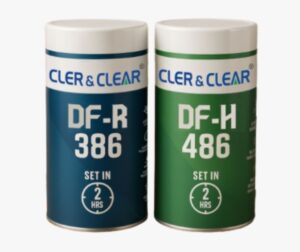
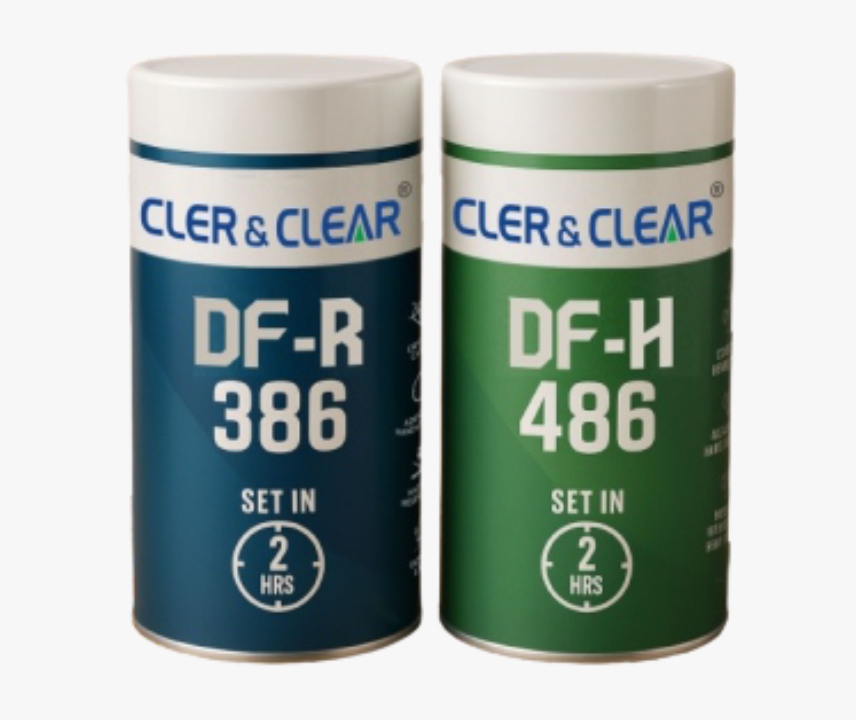
D+ Clear & Clear
- Categories: Epoxy Adhesive
- Availability: In Stock
- Product Type: Variable

DF-R 386 & DF-H 486 is a clear epoxy system suitable for both large-scale DIY applications and industrial use. It is described as free from strong or unpleasant odour and is suitable for making artificial jewellery, handicrafts, decorative artefacts and various engineering components.
The system provides a strong and long-lasting bond with a clear finish, making it suitable for decorative work. It is resistant to water and chemicals and can withstand heat and dynamic conditions. It is also suitable for multiple surfaces including wood, stone, textile and jewellery.
Advantages
- Strong and long-lasting bond.
- Clear finish suitable for decorative work.
- Resistant to water.
- Resistant to chemicals.
- Can withstand heat.
- Can withstand dynamic conditions.
- Suitable for multiple surfaces.
- Free from strong or unpleasant odour.
Application
DF-R 386 & DF-H 486 is suitable for:
- Wood handicrafts – bonding wooden parts, decorative joints and furniture pieces.
- Stone handicrafts – joining and repairing marble, granite and decorative stones.
- Textile applications – fixing zari, embellishments and decorative elements on fabrics.
- Art and craft work – assembling, coating and fixing art materials and handmade products.
- Jewellery
- Engineering items
Suitable Substrates
The datasheet lists the following suitable substrates:
- Concrete
- Brick masonry
- Concrete masonry
- Cement mortar beds
- Gypsum wallboard
- Ceramic tile and stones
- Non-water-soluble cut-back adhesive
- Vinyl or other resilient tile
- Plastic laminate
- Cement backer board
- Steel
- Cement plaster
- Cement terrazzo
- Exterior glue plywood
Application Process
Surface Preparation
The datasheet instructs that tiles should be firmly set and adhesive or mortar should be completely dry for 24 hours. Spacers, pegs, ropes and strings should be removed, and joints should be cleaned of loose dirt. A mock-up installation is required before the actual installation.
Mixing
Complete units should always be mixed because Part A and Part B are packaged to the exact quantity ratio. Partial mixing can result in improper or no curing of the grout. Part A and Part B should be mixed with suitable aggregates using a slow-speed stirrer until a homogeneous, consistent mix is obtained.
Application
Press the grout firmly into the joints using a hard rubber squeeze, ensuring that the joints are completely filled. Remove excess material by moving the squeeze diagonally across the grout lines.
Cleaning
Surplus grout should be cleaned from tile joints and surfaces after 20–25 minutes with D Shine. A rough textured sponge dampened with clean water should initially be used, followed by a damp sponge in a circular motion. Grout haze can then be cleaned with clean water or soap solution.
Chemical Resistance
The datasheet gives the following chemical resistance information:
| Chemical | Resistance |
|---|---|
| Methanol | Excellent |
| Ethanol | Good |
| Xylene | Excellent |
| Butyl Cellosolve | Excellent |
| 1,1,1-Trichloroethane | Excellent |
| 10% Lactic Acid | Excellent |
| 10% Acetic Acid | Excellent |
| 70% Sulfuric Acid | Excellent |
| 98% Sulfuric Acid | Excellent |
| 50% Sodium Hydroxide | Excellent |
| 10% Sodium Hypochlorite | Excellent |
| MEK |

Additional information
| Style | Bottle, Jar |
|---|---|
| Size | 1.8 kg, 200 gm, 450 gm, 900 gm |
Be the first to review “D+ Clear & Clear”
Similar items
D+ Hippo Quick-LV